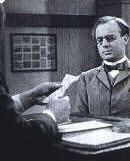
The Fire tongue bowl

|
The Fire tongue bowl |
|
This is the most popular film of Heinz Rühmann in German. Heinrich Spoerl wrote the story, and Rühmann filmed it twice: once in 1934 as "Such a boor" - quite different from the original story - and once in 1944.
It is the story of Hans Pfeiffer who was never in a real school: a school with escapades, eccentric teachers and first love. He is encouraged to return to school "for scientific reasons". He, who had only teachers at home and now has his PhD shall go back to high school.
He is successful, even so his own world - represented by his girlfriend - tries to get him back. In the meantime he can fool around without danger of consequences.
"How many F in Pfeiffer, one or two? - Three, one before the ei and two after".
School is stopped when the students put a sign "Construction zone - no access"
He sits in the school prison and becomes the hero of two school girls.
In science class they learn about fermentation. When trying a fruit cooler they simulate to be drunk, even so everyone only had one sip.
And finally he is imitating his teacher - and has to continue when the school inspector arrives.
And of course he wins the heart of Eva Knauer, daughter of the school director, against a competing teacher.
| Such a boor | |
|
Premiere: February 13th, 1934 in U. T. Kurfürstendamm (Berlin) |
|
| Heinz Rühmann (in a double role as Dr. Hans and student Erich Pfeiffer)
Ellen Frank (Marion Eisenhut) Regie: Robert
A. Stemmle |
First version, very different from the original text. The succesful author Hans Pfeiffer wants to write a play about school. To collect more material he takes the place of his brother, high school senior. While he enjoys schoolboy live, his brother tastes life in a big city. Love comes to both of them. |
| The fire tongue bowl | |
|
Premiere: January 28th, 1944 in U. T. Königstadt and Tauentzien Palace (Berlin) |
|
| Heinz Rühmann (Dr. Johannes Pfeiffer)
Karin Himboldt
(Eva Knauer)
Albert Florath, Georg Vogelsang, Karl Etlinger, Georg Heinrich Schnell (friends around the fire tongue bowl) Regie: Helmut
Weiß |
The succesfull author Johannes Pfeiffer has never been
to school. After lots of drinks, his friends encourage him to change that. Dressed with a schoolboy's cap he starts school live. He lives at Mrs. Windscheid, a caring widow. Many of his teachers are eccentric and he plays a lot of tricks, till he meets his great love: Eva, daughter of his director. But she does not want to marry a high school boy and does not believe that the his a prized author, so he has to prove it: He will do his final trick: He changes the alarm of his teacher Schnauz, invites the schoolgirls of a girl school into the science class and acts himself as teacher. But suddenly the school supervisor arrives in class ... |
from Heinz Rühmanns memories about this movie
I did not want to play this role. I thought that with 41 years i was to old. I only agreed after some tests.
1943 we got the bad news from Berlin: "Fire tongue bowl" was forbidden. The secretary of education had prohibited the move because "it was already difficult to find teachers", und such a movie would dishonor them. Then a call: i should come with the movie to the Führerhauptquartier (Hitler's headquarter). The movie was shown late at night. The next day i learned that it was a great success. Göring reported to Hitler that the movie was prohibited. Hitler asked "was it really that good? Then let him be shown!"
The introduction
This movie is a declaration of love to school, but it can be that school does not notice anything.
A very funny movie, where the serious thoughts of the start and the end remain hardly noticed: why do students provoke teachers? Which education method is the best?
In this movie, senior teacher Brett and the old teacher Bömmel have a discussion: respect of students, of course, but discipline is stick that makes the tree grow straight? Maybe this is also the solution to the question: good teachers achieve by giving the example that there are no exaggerations.
This movie was initially prohibited because in 1944 and before school was far more authoritarian than today. Inside discussions between teachers about authority were very unlikely. And if some parts show these discussions, than the might have been entered to ease the conflict with the general authoritarian environment.
In this context it is worth mentioning that the discussion between the teachers (see above) is not part of the original text of Heinrich Spoerl, but have been added to smooth the suspicions of the authorities. In the contrary, a scene from physical education (the teacher Brett does calisthenics, they do not participate what he does not see because he turns his back) is only in "Such a boor". Probably this was to bold in sport-crazy Nazi times. In the original text, teacher Dr. Brett is not the smart teacher (this is "Müller 2"), but a snappy math teacher.
More in the background is "little Luck", who in the original text puts the "Construction Zone" sign all alone. He is a common figure in Spoerls other stories: a hard working student, smart but despised by the big and strong ones. This "little man", played many times by Heinz Rühmann after the war, was not a popular figure in Nazi times and became a regular and low key figure in this movie.
Both movies show another conflict: the poet Hans Pfeiffer who switches from glamorous Marion Eisenhut to natural (and in the second movie motherly) Eva Knauer. The elegant lady from Berlin cannot understand why Hans likes the live in a small city.
Fire tongue bowl - what is this?
An old fashioned drink: red wine is seasoned with cinnamon and orange (or mixed with orange juice), and cooked in an open bowl. Large pieces of sugar are put on a fire pincer above the bowl, soaked with rhum and put on fire. The melting sugar drops into the bowl.
Trailer
True are also the memories that we carry with us, the dreams that we develop and the hopes that push us. This should be sufficient for us.
Sources: Heinz Rühmann's autobiographie "Das war's", Ullstein-Verlag 1982, "Heinz Rühmann und seine Filme" by Gregor Ball and Eberhard Spiess, Citadel Filmbuch of Goldmann Magnum 1982, "Das große Heinz Rühmann Buch" edited by Naumann & Göbel and "Heinrich Spoerl's gesammelte Werke" edited by Piper-Verlag 1965