Good Soldier Schweik

|
Good Soldier Schweik |
|
|
Premiere: Sep 22, 1960 in Ufa-Palast (Köln) after a novel of Jaroslav Hasek |
|
| Heinz Rühmann (Jozef Schwejk)
Ernst Stankowski (Lieutenant Lukas) Director: Axel von Ambesser |
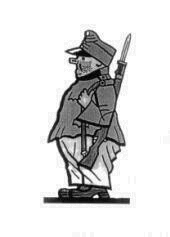
The bohemian dog dealer Schwejk lives peacefully in Prague when the First World War starts. First, he is imprisoned for high treason, finally he becomes a hero and soldier. He is simple and clumsy, and so survives all kinds of situations and dangers: in the military hospital and then as officer boy. He has to settle delicate female affairs for his lieutenant Lukas. But when he brings him a dog, which in reality belongs to another officer, the two are moved to the front. In the train the clumsy fellow disturbs again, and as he pulls the emergency brake, he has to leave the train, to walk to the front and is finally arrested as a spy. He arrives a long time after his lieutenant, again spells trouble for the lieutenant who had found a position out of danger: they both have to go into the battle. Schwejk ends before the court martial, but armistice saves him in last second. "After the war around 6 o'clock" he sits again in his favorite restaurant where everything began, together with his friend Woditschka, the pub owner, the owner's wife and the secret police man. The emperor lost the war, Woditschka his leg, but " the war, we will remember it for weeks". |
A bitter-bad satire by the Czech nationalist Jaroslav Hasek on the k.u.k. Monarchy. The novel is very famous, perhaps the internationally most known piece of Czech literature. If the book is very much shaped by the nationalistic view, the film filters this out and makes the story a masterpiece independent of its time. This makes the movie famous, despite the obvious difficulties which Heinz Rühmann had with his role.
Heinz Rühmann had exercised the Bohemian-German accent for weeks, then the scenes had been remade in north German accent for the sake of understanding.
From Heinz Rühmann's memories about this film:
"The brave soldier Schwejk" is the movie I prefer. Probably because of the fact that I had larger difficulties with this figure than with the shoemaker Voigt. I could not get a grasp on the dogcatcher "Schwejk, Josef" for a long time, despite the friendly assistance by the director Axel von Ambesser. The main question to be asked and answered by each actor about this figure: Is Schwejk stupid, or does he only pretends to be? How much intelligence is in his head? I left the question open.
This "idiot" says so intelligent things like: "war is only for rich people". Or another scene: He looks for in vain the front, although the war takes place "next door", runs in circles and regains in such a way on an old carriage where he finds his pipe and tobacco, which it had forgotten there. His conclusion: "everything has its own sense!" Schwejk Joseph is a such a dazzling figure that I was always sad after a scene was finished, because I could have played it still in various other ways.
There were so many beautiful scenes. There is that one of the end of "his" first lieutenant Lukas: Around both the battle raves. Shells explode. The captain and Schwejk threw themselves in cover. The officer thinks of his last girl in Prague, wants to become solid, between him and Schwejk the first human contact develops. The first lieutenant regards his boy who presents a four-leaf clover to him: "I want to give it to you because it brings luck", there only Schwejk realizes that Lukas is death. Schwejk takes his beloved lieutenant on his shoulder and carries him, without being wounded, through the shells and splinters of the battle. Proves to be true, what once Lukas said: "Schwejk, you are so stupid, you are invulnerable."
Or: Schwejk sits as an alleged spy in prison, and the priest comes, in order to help him during his last hours, but Schwejk does not understands, but comforts the clergyman, because he believes that he is locked up, too. He asks: "Is this your first time here?"