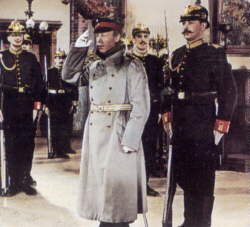
The Captain from Köpenick

|
The Captain from Köpenick |
|
|
Premiere: Aug. 16th, 1956 in Ufa Palace (Cologne) Script/play by Carl Zuckmayer |
|
| Heinz Rühmann (Showmaker Wilhelm
Voigt)
Hannelore Schroth
(Mathilde Obermüller) Ilse Fürstenberg
(Marie Hoprecht) Friedrich Domin (Prison director) Regie: Helmuth
Käutner |
The shoemaker Voigt, who was an exemplary prisoner. But
when he is released he finds himself in the same vicious circle: without a job
no residence permit, without residence permit no job. Finally, he buys an old
uniform of a captain, takes some soldiers under his orders and marches into the
Köpenick city hall, hoping to obtain a residence permit by force. Uniform and soldiers both have their story: going down. In the beginning, the uniform is made by the court tailor for a captain. When he has to quit the army, it is sold to reserve officer and mayor Obermüller. Because of a whole it ends at the tailor and is carried after repaired by Miss Wormser at a dancing. Doused with champagne it goes to the junk dealer. Similar the track of Voigt: He finds a home at his sisters and seems to find a way back into regular life. But then he is expelled. After the death of Liesken he does not want to remain alive - and at this lowest point of his life he sees the uniform at the junk dealer. The way Heinz Rühmann plays this role is an essential part of the success. If there have been doubts about his ability to play serious roles these were overcome by this movie. The sequence where he reads the dying girl Liesken from Grimm's stories "The musicians from Bremen" is a highlight of art. |
|
|
The movie is based on a true story which happened on October 16th, 1906. 57year old shoemaker Voigt was sentenced to four more years of prison, but emperor Wilhelm II. granted amnesty after a short time. He was traveling through Germany and signing post cards with his picture in uniform. His popularity helped him to survive the rest of his life. |
|
"Hauptmann-von-Köpenick" web site This site (in German) is recommended for all those who want to learn more about the real Wilhelm Vogt. |
|
Carl Zuckmayer's play is one of the most important German literary works, and Helmuth Käutner's move is on the same level. The accusation of the bureaucratic system, that does not give a chance to an honest man but can be beaten by a rogue is perfectly written. It is also a warning against a system where a uniform is more important than the human being carrying it, and it shows the limits of obedience.
Three (silent) movies have been produced after the event, in a fourth in 1908, the real Voigt played himself. But this movie was prohibited. Carl Zuckmayer wrote the play in 1930 as a "German tale". Premiere was on March 5th, 1931 in the German Theater staged by Heinz Hilperts. The piece was played in many theaters till 1933.
Carl Zuckmayer about this play:
This was my fool, a poor devil, who shows the truth to a period and the people enlightened by hardship. Even so this story was 20 years old, it was very important in this moment, 1930, when the Nazis became the second party in the assembly and Germany became crazy about uniforms, to hold a mirror, a fools picture of the monkey business and the dangers that were growing in Germany, also in the hope to overcome them like the shoemaker by wit and intelligence.
Carl Zuckmayer about the movie:
Rühmann, staged by Käutner, gave the Prussian fool Wilhelm Voigt such a right and deep importance: laugh and tears were always close together. When he, having finished, released his solders "sausage and beer for every man" - one of the funniest parts of the move - he is showing such a fundamental sadness that you understand immediately the futility of trying to escape your own destination.
From Heinz Rühmanns memories about the movie
When we finished the sequence with the dying Liesken, when i was reading from Grimm's tales, it was three o'clock. I was waiting to move on to another scene. But is was so quiet in the studio and no one moved. And then he (Helmut Käutner, the producer) said in a very low voice "knock it off". These words said everything.
|
The captain from Köpenick opened in 1956 the international movie festivals in Venice. A year later they were shown at the international movie festivals in San Francisco. Heinz Rühmann got the "Golden Gate" as "Best actor". |
 |
Sources are Heinz Rühmann's autobiography "Das war's", edited by Ullstein-Verlag 1982, "Tagesschau in die Vergangenheit" by Hör Zu/Frank Lynder and Carl Zuckmayers autobiography "Als wär's ein Stück von mir", edited by Fischer-Verlag 1966.